
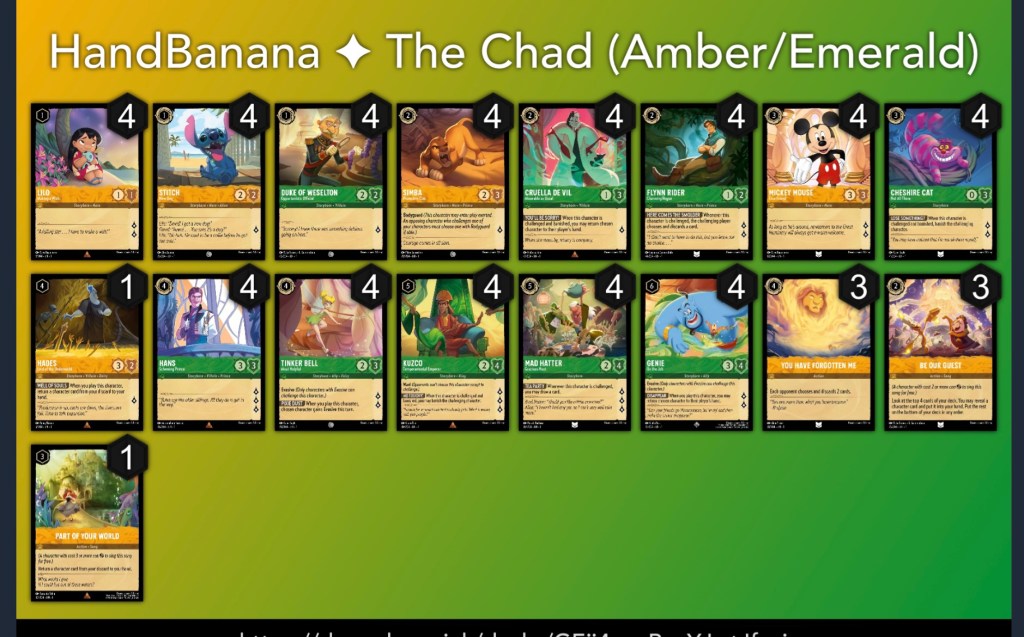
It’s been a few weeks since Lorcana released on Pixelborn and the amount of lessons I’ve learned has been quite overwhelming… in the best way possible. I’m not sure when I’ll obtain cards or if I’ll be participating in the competitive scene, but Lorcana’s base set so far offers a lot of room for exploration, deck tuning, and overall refinement of the “best” archetypes.
Today, I want to focus in on the color combination I first started with – Amber/Emerald “Aggro”. Here is the very first version of the deck I posted on August 28th:
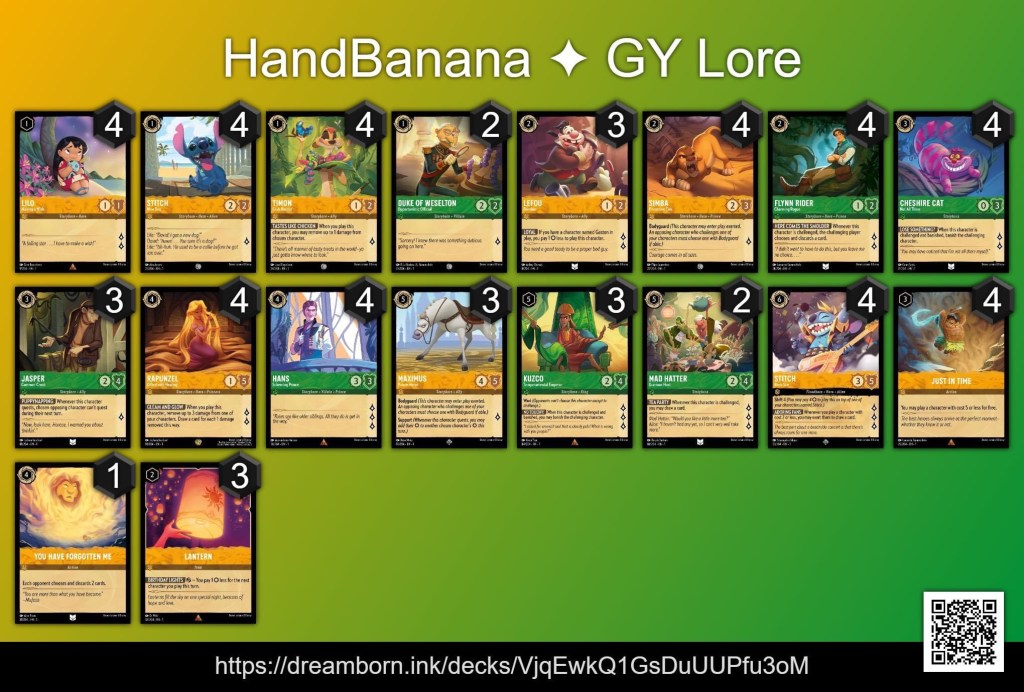
As you can see from my handiwork I was unfocused, unsure, and just trying to play cards I really liked based on experiences from other games.
In this part of my own process I really try to throw as many different cards into a deck as possible just to get a feel for the various cards, mechanics, curve, and the tempo of average games. What’s awesome about this part of the process is you really start to learn a lot about not just the cards in your deck, but how they play in the world around you. This then leads to you starting to explore decks that may be better homes for the cards you tried, that didn’t necessarily work out here.
From this point, I then started down the path of constructing Amber/Steel Midrange decks since I fell in love with the bodyguard keyword, removal options, and the incredible power of Stitch and Tinker Bell – especially when combined with Ariel, A Whole New World, and Grab Your Sword.
The love affair didn’t last too long though, as mirrors became more prevalent and most of the time it felt like who ever got to Ariel, Tinker Bell, and/or Stitch first was massively ahead. To the point where games were just decided by who could do a double activation of Grab Your Sword for the complete blowout.
It wasn’t just the mirrors though, as I still wholeheartedly believe that Ruby/Amethyst has the best matchup spread in the format and on any given day can be constructed to combat Amber/Steel. This is mostly due to Amber/Steel just not being fast enough, nor does it have a high number of true threats that constantly force Ruby/Amethyst into a tough spot as the game reaches the later stages. There’s no better top-end than Maleficent 9 and Elsa 8.
So… 17 days have past since I posted my first Lorcana deck, where are we now?
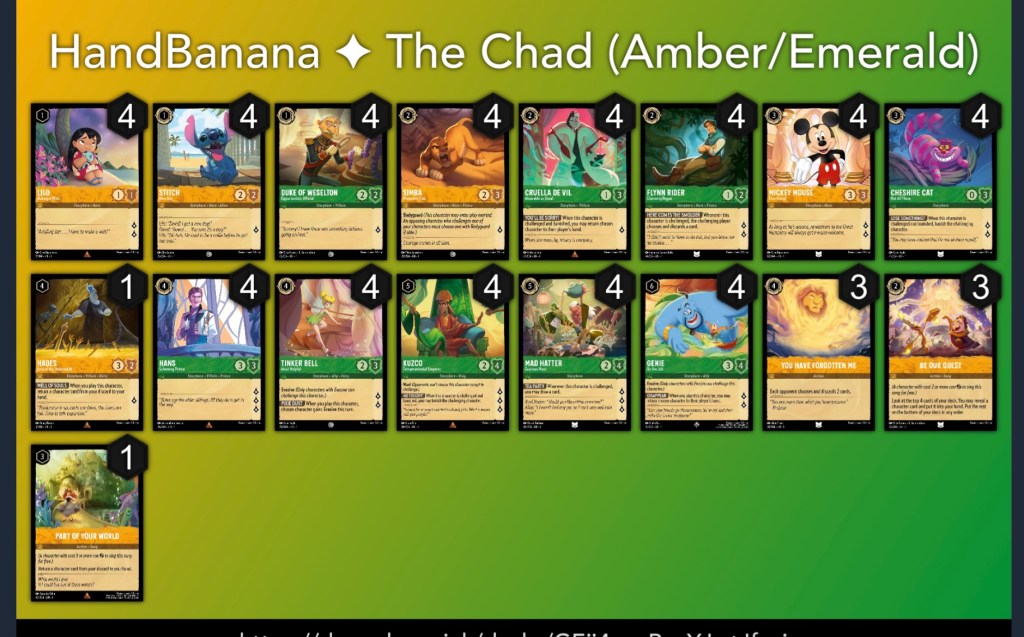
As you can see, I know exactly who I am and you can truly see just HOW BAD I WANT IT!
1 Cost Units – 12
4x Lilo
4x Stitch
4x Duke
Lilo is who you want all of the time, but you also just want some 1’s that can trade in the early game, put some lore on the board, and be inkable when the game starts to transition to the mid-late stages. It’s important to note that you don’t want to play too many, as they are often the absolute worst card to draw.
2 Cost Units – 12
4x Flynn
4x Simba
4x Cruella
Simba plus Lilo is always such an optimal start, but also there’s a lesson to be learned about patience when playing a deck like this – you just can’t turn your cards sideways every turn. There are a lot of games where you don’t have Simba and it’s important not to be too hasty in exposing your Lilo. There are scenarios where the optimal line is playing Lilo on 1, foregoing questing on 2, and playing Flynn to continue taxing the board. You then can go into Mickey or Cat on 3 and then wait to quest with all of them on turn 4 to get the max value possible, and make challenging awkward for the enemy player.
Flynn is also the guy you want to often expose when you’re trying to setup for You Have Forgotten Me. There are so many games where you’re going second and you instantly pull ahead with that line of play; especially when the enemy player is on control or midrange and they’re forced to ink every turn, driving down their handsize.
Cruella has the upside of being very sticky with 3 willpower and the ability to offer removal, which were very thin on here.
3 Cost Units – 8
4x Mickey
4x Cat
Cat is a problem that enemy players hate having to address and Mickey being a 3/3 also does a great job of being a lore threat that can lead to positive challenges for you. Neither cards are bad top decks, as more often than not when you’re so far ahead they end up trading for some of the enemy’s best removal effects – keeping you ahead.
4 Cost Units
4x Hans
4x Tinker Bell
1x Hades
Hans always has to die, but he also always gets his money. This leads me to another segue, as it’s important to realize that when playing against midrange and control your goal is to build a lead, whittle away at the enemy’s resources, and tax their removal with lethal threats, like Hans.
Tinker Bell’s inclusion came from my exploration phase where I played a ton of Emerald/Steel Midrange; this is where I learned about how amazing evasive units are! Tinker Bell and other evasive threats are so powerful since they force the enemy player to use a piece of removal, and in some cases even trade for a Be Prepared, all on their own.
The inclusion of Hades is to demonstrate just HOW BAD I WANT IT. Kuzco is the best card in the deck and we want more copies of Kuzco. Hades is also a flex slot dependent on the metagame. If the field is more Amber/Steel, you probably want Mother Knows Best as a way to bounce an Ariel or Tink 3 to stop the song combos. If the field is more Ruby/Amethyst, you’ll want to stick with the recursion from the discard pile that Hades offers.
5 Cost Units
4x Kuzco
4x Mad Hatter
Both of these quest for 3 lore, but Kuzco limits the points of interaction for the enemy player. In a lot of my games I’m very patient with deploying Kuzco, unless I’m so far ahead it doesn’t even matter. In the most prevalent matchups you’re constantly dancing around cards like Maui, Grab Your Sword, Be Prepared, etc. so you’re usually trying to have Kuzco be the last man standing.
I think I’ve maybe drawn 2 cards off of Mad Hatter in my lifetime, but that definitely doesn’t take away from how strong the card can be. This is especially true in low resource games where you’re just hoping to top deck a threat to continue filling your board or win the game outright.
6 Cost Units – 4
4x Genie
Christina Aguilera does not get enough love.
Anyway, so yea there’s that.
Really though, I’ve already explained how powerful being evasive is, but Genie is truly so much more. Genie’s bounce effect is obviously good for clearing problems that don’t have strong entering play effects, like Mickey 8, or Aladdin 7.
The true power of Genie, in my opinion, actually comes from being able to bounce your own threats, saving them from challenges, and establishing an evasive threat that must be dealt with; this is why we play the full 4 copies.
A great example is when it’s late in the game, you played a Kuzco last turn and you want to quest. Normally, there would be risk involved, but not anymore! Instead you can quest with Kuzco for full value, play Genie to bounce your Kuzco, and now you have an evasive threat in play. This then lets you play Kuzco safely and rely on ward to force the opponent into a situation where they have to have a Be Prepared, or they just lose.
Lastly, don’t sleep on Genie to bounce Genie to then replay Genie to bounce Genie.
Yo dawg, I heard you like Genies…
Songs and Actions – 7
3x Be Our Guest
3x You Have Forgotten Me
1x Part of Your World
Be Our Guest also = more Kuzco.
BOG is a card I’m learning to love more and more as it truly is a “swiss army knife” in this deck.
Part of Your World = more Kuzco.
Similar theory to Hades, but just wanted a song that we could free play in games we’re low on ink. Again, if the metagame is more Amber/Steel I’d probably opt for another Mother Knows Best.
You Have Forgotten Me, aka Cell’s Absorption, is a card that can read pretty medium if you haven’t played any games. Instead it’s a fantastic way to end a lot of games, or even a way to accelerate the enemy player into top deck mode when you’re ahead. YHFM also is a card that lets you punish the game’s resource system, which can be quite an advantage if you’re going second if the enemy player inks and plays a 1 cost unit, putting them down to 5 cards already. YHFM is also your way to punish ink hungry control decks that want to have 9+ cards in their inkwell.
Final Thoughts
I’m actually kind of bummed that new cards are already being previewed, as I feel that the puzzle of base set 1 is definitely not 100% solved when it comes to archetype refinement. I do think that the best 3 decks are Ruby/Amethyst Control, Amber/Steel Midrange, and Amber/Emerald Aggro – as they all tend to check each other fairly well and capitalize on the weakness of other color combinations.
As for my build, “The Chad”, I really tend to enjoy the simplest competitive archetypes because they often are the most rewarding since you put the enemy on a clock and all you’re trying to do is race to the finish line before crashing. And shoot, what could be more “Chad” than jamming cards with the highest lore values into a singular deck?
My advice for you brewers out there just getting into the game: brew away and enjoy the creative space that Lorcana’s base set offers. For the tuners and netdeckers: there is so much room for refinement and so much information at our disposal already, keep on learning and keep on tuning.
 3xG Productions